

_By Oladipo Akinsete | Culture Columnist & SSA Protocol and Public Affairs | diipoakinsete@yahoo.com_
There is a popular cliché that has followed Lagos for decades: “Lagos is mad.”
It is said casually in traffic jams, written confidently by travel bloggers, and repeated even by Lagosians themselves.
But this cliché is not only lazy, it is a fundamental misreading of the city. Lagos is not mad.
Lagos is energetic. And our inability to distinguish between energy and madness says more about our post-colonial lens than it does about the city itself.
Long before Lagos became a megacity of over 20 million people, the people of Eko had developed a sophisticated framework for understanding energy.
They understood that iron has a spirit, that water has a memory, that thunder has a voice, and that crossroads have consequences. We called this framework Orisha.
The colonial translators, unable to understand a religion without a single book, translated it as “gods.”
And decades later, Nollywood, in its search for villains, caricatured these principles as bloodthirsty, white-eyed entities. This was a distortion.
Ogun was never a god of madness. Ogun is the metaphysical principle of iron, technology, and innovation.
Today, Ogun lives not only in the shrine in Ire, but in the workshops of Ladipo and the startups of Yaba — anywhere where metal and mind are used to create.
Olokun and Yemoja are not mermaids to be feared. They are the principles of the aquatic economy that sustains Lagos — the same lagoon that gave us fish, trade routes, and now, land.
Esu is not the devil. Esu is the guardian of the crossroads, of choice and consequence.
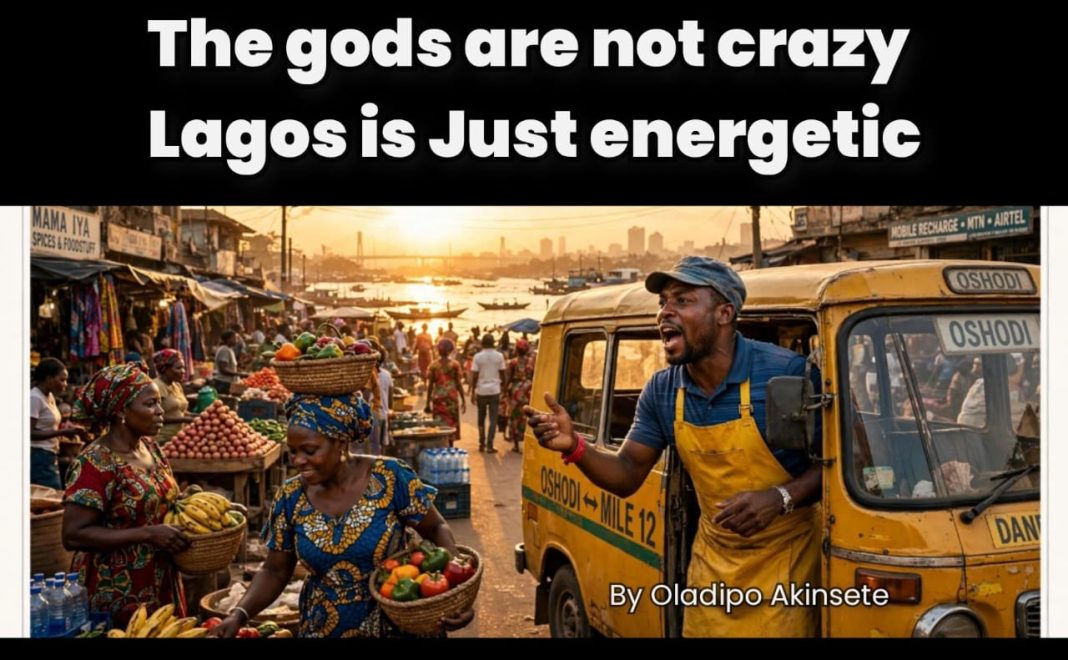
And what city has more crossroads than Lagos? Every day in Oshodi, in CMS, in Mile 2, Lagosians must make rapid, life-defining decisions.
That is not chaos. That is Esu at work. Lagos did not abandon its gods. It simply modernized them.
Why then does this energy look like madness to the outsider? Because Lagos is one of the few cities in the world where over 20 million ambitions are compressed into 3,577 square kilometers.
In many Western cities, energy is queued, regulated, and hidden behind polite structures. In Lagos, energy is contested, negotiated, and performed in public. The danfo conductor shouting his route is not exhibiting insanity; he is engaging in acoustic survival in an economy where silence means hunger.
The market woman who fries akara, receives a bank transfer, and negotiates with a customer while on a Bluetooth call is not confused.
She is operating at a level of cognitive multitasking that formal economic theories have failed to capture. What we call “hustle” is simply high-frequency human vibration.
It is exhausting to watch, but it is what has kept this city alive without social welfare, without constant electricity, and without apology.
Lagos is perhaps the only city in the world where a church, a mosque, a traditional shrine, and a nightclub can coexist on the same street — and all record full attendance on the same Friday.
This is not religious confusion. This is spiritual abundance. The average Lagosian has enough existential bandwidth to pray at dawn, negotiate a contract at noon, attend a traditional naming ceremony in the evening, and still make it to an owambe on Saturday.
We are not conflicted. We are complete. .
Therefore, to call Lagos mad is to pathologize what is, in fact, resilience.
The future of Lagos does not lie in trying to calm it down. You do not calm electricity; you channel it.
The task for urban planners, cultural custodians, and storytellers is not to make Lagos quieter, but to make its energy more productive and less punishing.
The gods were never crazy. They were simply the first Lagosians — energetic, loud, industrious, and unwilling to be ignored.
If you come to Lagos looking for quiet, you will find madness.
But if you come looking for life, you will find a city with too much life for a single body to contain.